see German version below
Katrin Klose (*1990) was given her first violin lessons at the age of six years, piano lessons followed in 2001. At the age of sixteen she was accepted as a violin student at the Conservatory of Nürnberg with Valerie Rubin. In 2015, she graduated teaching music for secondary schools and BA composition at the Würzburg University of Music after studying with Prof. Heinz Winbeck, Tobias Schneid and Prof. Robert HP Platz. There, she also worked as a tutor for music theory and historical vocal improvisation.
In 2018, she graduated Masters in Composition at the University Mozarteum in Salzburg under the tutelage of Prof. Reinhard Febel. In Salzburg, she was engaged as an assistant in the programme area ‘Contempohr – mediating contemporary music’.
In 2023, she finished her PhD in Composition titled ‘You can’t do that - A journey into vocal composition through an exploration of musical genres and the subversion of norms’ at the Royal Conservatoire of Scotland with Dr Stuart McRae and Dr Jonathan Cole from the Royal College of Music in London. She is also committed to teaching analysis, notation and master’s studies for composition students at the Royal Conservatoire in Glasgow.
She was awarded the first prize at the International Composition Competition of the City of Homburg in 2013. In 2015 she won the Prize for Cultural Promotion of her hometown Amberg as well as a composition prize for string quartet tendered by the Hugo Wolf Quartet, the Alban-Berg-Stiftung and the Jeunesse Austria. In 2020, she won the call for scores in the category chamber orchestra at the festival tuns contemporans in Switzerland. At the 4th international composer competition New Music Generation in Kazakhstan, her piece won in the category vocal composition. In 2025, she was awarded the Bavarian composition prize for choral works.
She is awardee of numerous studentships such as the Deutschlandstipendium, Youth Cultural Advancement Award of the city of Amberg, the Leistungsstipendium and the Ordentliches Stipendium of the University Mozarteum, the Jahresstipendium Musik des Landes Salzburg, the RCS Research Studentship and the PhD Studentship of the Studienstiftung des Deutschen Volkes etc. For 2021/22, she was granted an artist residency at Marchmont House Scotland and a six-month residency at the Cité internationale des Arts in Paris.
Her music is performed by notable ensembles such as the SWR Symphonieorchester, the Hugo-Wolf-Quartett, Ensemble der gelbe klang, OENM Salzburg, the Red Note Ensemble, Ensemble NAMES, Tiroler Kammerorchester etc. at workshops and festivals like the DIALOGE Festival Salzburg, tuns contemporans, Glasgow Cathedral Festival, PLUG Glasgow, Tage der Alten Musik Würzburg and the German Choir Competition. Her works are published by Laurentius-Musikverlag and Are Verlag.
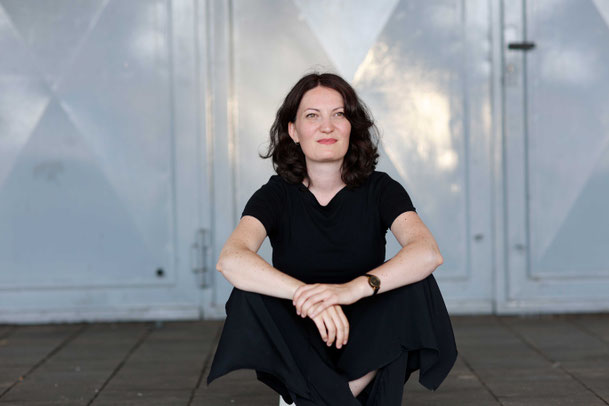
Foto © Astrid Ackermann
Katrin Klose (*1990) studierte Violine als Jungstudentin bei Prof. Valerie Rubin an der Hochschule für Musik Nürnberg. 2009-2014 folgte ein Studium an der Hochschule für Musik Würzburg im Fach Lehramt Musik an Gymnasien und ab 2010 zusätzlich BA Komposition bei Prof. Heinz Winbeck, Tobias PM Schneid und Prof. Robert HP Platz. An der Hochschule für Musik in Würzburg war sie als Tutorin in den Bereichen Tonsatz und historische Vokalimprovisation tätig. Von 2015-2018 studierte sie MA Komposition an der Universität Mozarteum in Salzburg in der Klasse von Prof. Reinhard Febel. In Salzburg war sie im Forschungsschwerpunkt Contempohr – Vermittlung zeitgenössischer Musik als Studienassistentin tätig. Von 2018-2023 absolvierte sie ein Doktoratsstudium mit dem Schwerpunkt Vokalkomposition am Royal Conservatoire of Scotland in Glasgow bei Dr. Stuart McRae und bei Dr. Jonathan Cole vom Royal College of Music in London. In Glasgow unterrichtete sie Analyse, Notation und Master’s studies für Kompositionsstudierende.
Ihre Musik (z.b. 1. Streichquartett, Accord für Kammerorchester, In die Sonnenweiten.Lebwohl für Symphonieorchester etc.) wurde mit zahlreichen Kompositionspreisen ausgezeichnet. Außerdem erhielt sie den Kulturförderpreis der Stadt Amberg sowie das Jahresstipendium des Landes Salzburg in der Sparte Musik. Sie ist mehrfache Stipendiatin unter anderem des Deutschlandstipendiums, des Leistungs- und Studienstipendiums der Universität Mozarteum, des RCS Research Studentships sowie der Studienstiftung des Deutschen Volkes. 2021/22 verbrachte sie sechs Monate an der Cité Internationale des Arts in Paris als Stipendiatin des Bayerischen Staatsministeriums für Wissenschaft und Kunst.
Ihre Stücke wurden von namhaften Ensembles wie dem SWR Symphonieorchester, dem Hugo-Wolf-Quartett, Ensemble der/gelbe/klang, OENM Salzburg, the Red Note Ensemble, Ensemble NAMES, Tiroler Kammerorchester etc. bei Workshops und Festivals wie dem DIALOGE Festival Salzburg, tuns contemporans, Glasgow Cathedral Festival, PLUG Glasgow, Tage der Alten Musik Würzburg oder dem deutschen Chorwettbewerb aufgeführt. Ihre Werke werden im Laurentius Musikverlag und im Are Verlag verlegt.
*1990
2007-2009
Pre-College student for violin at the Hochschule für Musik Nürnberg with Prof. Valerie Rubin.
2009–2014
Teaching degree for music in secondary schools at the Hochschule für Musik Würzburg.
2010–2015
Bachelor in Composition at the Hochschule für Musik Würzburg with Prof. Heinz Winbeck, Tobias PM Schneid and Prof. Robert HP Platz.
2015-2018
Master in Composition at the University Mozarteum in Salzburg with Prof. Reinhard Febel.
2018-2023
PhD in Composition at the Royal Conservatoire of Scotland in Glasgow with Dr. Stuart MacRae and Dr. Jonathan Cole
The Fortepiano by Johann David Schiedmayer
Johann David Schiedmayer, a renowned instrument maker, was born in Erlangen in April 1753. He studied with Johann Andreas Stein in Augsburg and then became Court Instrument Maker in Erlangen. He moved to Nuremberg in 1797 where he established his workshop and died on 20 March 1805. As Schiedmayer's first biography, published in 1821, succinctly states:
Here the pupil seemed to surpass the master, striving with tireless zeal to bring his fortepianos to the highest possible degree of perfection.
These few words briefly summarize the outward course of his life.
The rapidly growing reputation of the young piano maker in Erlangen is reflected in the accounts of his contemporaries. Hereby, a description published in Cramer's Magazin in December 1783 of a fortepiano completed that same year is of particular interest. It refers to the surviving instrument No. 7 - the very instrument heard on this recording.
The seventh instrument was acquired by Herr von Kerpen, Canon of the Cathedral Chapter in Würzburg where it was received with particular acclaim. The agreed price was 300 florins. It left my workshop on 5 December 1783, and I personally travelled with it to Würzburg.
This instrument is one of a kind, not only because of its exquisitely crafted and tastefully designed case, executed with the utmost painstaking care, but also because of its extraordinarily ingenious, light, and even action. As responsive as the finest clavichord, it speaks with perfect egality in every register, from the lowest bass to the highest treble; in the upper register, it sings with the silvery tone of a flute, while the bass when struck with detached touch resembles the sound of a bassoon. Without the use of any stop or foot pedal … the instrument can swell gradually from the gentlest pianissimo - the faintest breath of love - to the most overwhelming fortissimo. With nameless speed, the hammers strike the strings and, thanks to the swiftest release, rebound again fast as lightning.
Schiedmayer's instruments found their way to cities such as Riga, Trieste, Livorno, Dresden, Leipzig, and Hamburg. Every instrument was built entirely by his own hand, and the construction of a single fortepiano could take up to ten months. This extraordinary investment of time is reflected in the exceptional craftsmanship and precision of his work, qualities that continue to distinguish his instruments to this day.
- Micha Kämmle
Mozart and the Glass Harp
The glass harmonica, the predecessor of the glass harp, was a well-known instrument in Mozart's Vienna. Its popularity was closely connected with the era's fascination with the supernatural. The physician and healer Franz Anton Mesmer used the glass harmonica as part of his treatments. An accomplished performer himself, he employed its sound to induce a relaxed, hypnotic state in his patients. Mozart was captivated by the instrument's unique timbre, a fascination that later mainfests in his Adagio and Rondo for glass harmonica, flute, oboe, viola, and violoncello (K. 617).
The primary difference between the glass harmonica and the glass harp lies in their construction. Whereas the glass harmonica consists of nested glass bowls mounted on a rotating spindle, the glass harp is made up of tuned drinking glasses arranged side by side on a board. The rims of the glasses are set into vibration by moistened fingertips.
The music aesthetician Christian Friedrich Daniel Schubart wrote:
The lyrical player is made for this instrument. If lifeblood seems to drip from the tips of his fingers; if every note he plays is a heartbeat; if he can convey rubbing, gliding, and tickling, then let him approach this instrument and play.
In Katrin Klose's compositions, however, the glass harp is not employed as a historical instrument. Its sonic possibilities are treated freely, making it less a reconstruction of historical practice than a quote to Mozart.
Sylvia Ackermann and Katrin Klose in Conversation
Katrin: Sylvia, the idea for this project came from you. How did it evolve?
Sylvia: I have been playing historical instruments for many years, and I love them and everything that comes with them - the artistic research, immersing myself in the lives of composers, finding my way into another world and another era. But I'm not particularly conservative, so I also wanted to create something contemporary. I wanted to catapult these compositions into the present while allowing them to remain historical at the same time. The idea of thinking about historical instruments in a modern way fascinated me. I'd had this project in mind for years and was always searching for the right composer. Three years ago, I happened to perform one of your works in a competition, without knowing you personally. From that moment on, I knew I wanted to ask you.
Katrin: Why Mozart? Why his slow movements? What is it about them that fascinates you?
Sylvia: Mozart has become my special field because I have these very special instruments for his music. The Schiedmayer is the Mozart instrument. It has remained virtually untouched over the centuries, and no one presumably played it for more than two hundred years. It was discovered in a cellar in the 1990s and immediately restored to the condition it remains in today. That means we can encounter Mozart's original sound world through this instrument, and that is what fascinates me.
And yes, Mozart is my favourite - but I can't really explain why. It's like love: you simply can't explain it.
For me, slow movements are always a composer's most personal statements. A sonata-form movement - with its exposition, development, and recapitulation - is something every composer has to master. It is where compositional technique is put to the test: how do you invent ideas, develop them, transform them?
But nobody tells you how to write a slow movement. As a performer, here I always feel most free. My main aspiration is to "sing" on the keyboard, even though the piano cannot literally sing. I connect the notes, and when I play, I feel like a singer.
Katrin: What was it like for you to perform contemporary music on this particular instrument?
Sylvia: It almost felt like liberation - to finally be allowed to play completely contemporary as well. I simply felt wonderful playing it. It was the realization of an idea I had carried with me for years. It was almost paradise.
Katrin: So, free from the constraints of historically informed performance?
Sylvia: No, it's more metaphysical - or philosophical. A genuine kind of freedom. Not freedom from something, but simply freedom. I don't feel constrained by historically informed performance at all. On the contrary - that's exactly what I love about it. My love for the instrument, the composer, and the music itself is what makes me feel free.
Katrin: Did it feel like entering new terrain - or even a wilderness?
Sylvia: I wouldn't call it a wilderness. Rather, I encountered something I had imagined—and then you composed it. It's like meeting someone for the first time and immediately feeling as though you've known them forever.
That's how your music feels to me – that’s ideal.
Katrin: How would you describe the process from the initial idea to the finished programme?
Sylvia: The longest part was finding a composer who was genuinely interested in the concept. Once I met you, everything happened very quickly. We chose the movements together, you composed, I experimented with them .Then Izabella joined us and improvised, bringing an entirely new musical dimension. Of course I practised, you continued composing. And together we discussed everything and revised it. Looking back, the whole process feels remarkably effortless.
Katrin: Yes, that's true for me as well. At first, though, it was quite technical. I had to get to know the instrument - I had no experience with the fortepiano. I first needed to understand its various timbres and registers, to discover what makes it unique so that I could honour those qualities in the compositions. I also came to understand Mozart in a completely new way. I'm not specialised in Mozart’s music, but through this project I learned a great deal about him.
Naturally, the pieces took time to emerge. It wasn't a lengthy process. It unfolded gradually until, at some point, it became completely clear what each piece needed to be. Most of them were actually written in a single day. With miniatures like this, that kind of process is possible.
Sylvia: The slow movements are your source of inspiration, whereas Izabella's improvisations deliberately set themselves apart from them. Her music opens up yet another dimension. It's an unintended one - which is something I also love about life: when unexpected things happen and not everything is causally connected.
The two of us forged the overall concept together, experimenting with it throughout, and then Izabella, with the glass harp, became the element that added yet another layer of fascination.
What makes this collaboration stand out is that each of the three of us contributes something highly indiviual. It is precisely this combination that gives the project its unique identity.
https://www.youtube.com/@katrin-klose-komponistin9427
https://www.facebook.com/katrin.klose.35/
@kaddyiek